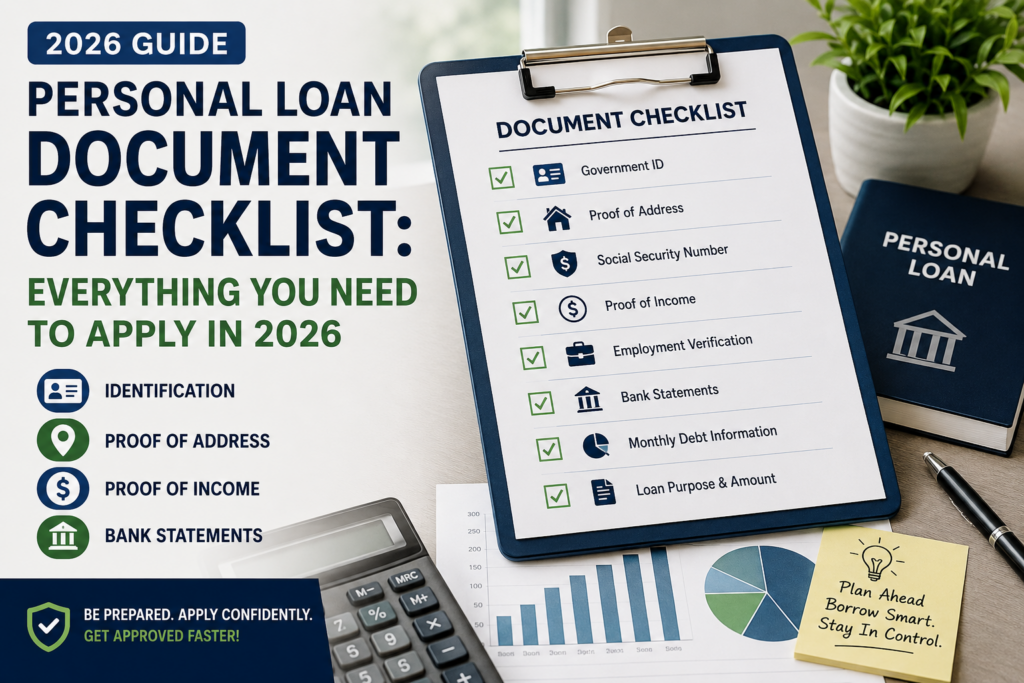
Personal loan document checklist preparation can make the application process faster, easier, and less stressful. Although every lender has different approval standards, most will ask for documents that confirm your identity, address, income, employment, banking information, and ability to repay the loan.
Gathering your paperwork before applying may help you avoid missing information, verification delays, and repeated requests from the lender. This guide explains the most common documents needed for a personal loan, including what traditional employees, self-employed applicants, retirees, and borrowers with different income sources may need.
Quick answer: Most applicants should prepare a government-issued photo ID, Social Security number, proof of address, proof of income, employment information, recent bank statements, and details about their current monthly debts.
Loan approval, loan amounts, rates, repayment terms, and funding times are not guaranteed. Requirements vary by lender and according to each applicant’s financial circumstances.
Why Use a Personal Loan Document Checklist?
A lender needs enough information to verify your identity, review your financial situation, and determine whether the proposed loan payment appears affordable. Missing or inconsistent information can slow down the application process, even when the applicant otherwise meets the lender’s qualifications.
Using a personal loan document checklist gives you an opportunity to review your records before submitting them. It can help you confirm that names, addresses, income figures, and account information match across your application and supporting documents.
Preparing your documents may help you:
- Complete the online application more efficiently
- Respond quickly to verification requests
- Avoid entering incorrect income or employment information
- Identify expired identification before applying
- Review your current debts and monthly budget
- Compare loan offers with more accurate information
- Reduce avoidable processing delays
Applicants who are still evaluating their eligibility can first review the common personal loan requirements lenders may consider.
1. Government-Issued Personal Identification
A valid government-issued photo ID is one of the most important personal loan application documents. Lenders use identification to confirm your legal name, photograph, birth date, and other personal information.
Commonly accepted identification may include:
- Driver’s license
- State-issued identification card
- United States passport
- Permanent resident card
- Military identification
- Other approved government-issued photo identification
Check your identification before applying
Make sure the document has not expired and that the information is readable. Your name and date of birth should match the details entered on your loan application.
If your name recently changed, the lender may request supporting documentation, such as a marriage certificate, divorce decree, or court-issued name-change record.
2. Proof of Your Current Address
A lender may request proof of your residential address to confirm where you live and whether you meet any applicable state residency requirements. The document normally needs to show your full name, current address, and a recent date.
Examples of proof-of-address documents
- Utility bill
- Lease agreement
- Mortgage statement
- Bank or credit card statement
- Insurance statement
- Property tax document
- Government correspondence
- Vehicle registration
What if you recently moved?
If your identification still shows your previous address, prepare another recent document that displays your current residence. You may also need to explain how long you have lived at the new address.
Utah consumers can review information about companies providing consumer credit through the Utah Department of Financial Institutions.
3. Social Security or Taxpayer Identification Information
Most lenders request a Social Security number or other eligible taxpayer identification information. This can be used to confirm identity, conduct required verification, and review credit information when applicable.
Protect your personal information
Only submit sensitive information through a lender’s legitimate and secure application system. Confirm that you are using the correct website before entering your Social Security number, bank account details, or identification documents.
Be cautious when receiving an unexpected text message, email, or telephone call about a loan you never requested. Do not send sensitive information until you have independently verified the company.
4. Proof of Income
Proof of income helps a lender assess whether you have enough recurring income to manage the proposed monthly payment. The exact documents depend on how you earn your money.
Documents for traditional employees
- Recent pay stubs
- W-2 forms
- Recent federal tax returns
- Direct-deposit records
- Bank statements showing payroll deposits
- Employer contact information
How many pay stubs should you prepare?
Requirements vary, but preparing your most recent pay stubs can help demonstrate your current earnings. If your income changes because of overtime, bonuses, commissions, or seasonal schedules, the lender may request a longer history.
Documents for hourly or variable-income employees
Applicants whose earnings change from one pay period to another may need additional records. Consider preparing:
- Several recent pay stubs
- Year-to-date income information
- Previous W-2 forms
- Recent tax returns
- Bank statements showing recurring deposits
Enter your income accurately. Do not list irregular overtime, temporary bonuses, or reimbursements as guaranteed recurring income unless the lender’s application specifically allows them.
5. Employment Verification Information
In addition to income records, lenders may request information about your current employer and employment history.
Prepare the following employment details:
- Employer’s legal business name
- Your job title or position
- Employer’s telephone number
- Employer’s physical address
- Your original hire date
- Your employment status
- Your pay frequency
- Your gross income before taxes
What if you recently started a new job?
A recent job change does not automatically prevent approval. However, you may need to provide an employment offer letter, first pay stub, previous employment history, or another document showing that your income is expected to continue.
Borrowers looking for local application information can also read our guide explaining how to get a loan fast in Utah.
6. Recent Bank Statements
Bank statements may help verify your income, account ownership, recurring deposits, and current cash flow. A lender may also need your banking information to deposit approved funds or process electronic payments.
Your bank statements should clearly display:
- Your name
- The financial institution’s name
- The account number or masked account number
- The statement period
- Recent deposits
- The current or ending balance
Avoid editing financial records
Submit complete and accurate records. Do not crop, modify, or alter financial documents unless the lender specifically instructs you to hide certain information.
If the lender accepts digital documents, download official PDF statements directly from your bank’s online portal rather than sending screenshots whenever possible.
Applicants who do not use a traditional checking account can review our guide to a loan without a bank account in Utah for general information about potential limitations and alternatives.
7. Information About Current Monthly Debts
Lenders may ask about your current financial obligations to evaluate how a new payment could fit into your budget. This information may also be used to estimate your debt-to-income ratio.
Prepare information about:
- Credit card minimum payments
- Auto loan payments
- Student loan payments
- Mortgage or rent obligations
- Existing personal loans
- Child support or alimony obligations
- Other required monthly debt payments
Debt-to-income ratio example
Suppose your gross monthly income is $4,000 and your required monthly debt payments total $1,000.
$1,000 ÷ $4,000 × 100 = 25% debt-to-income ratio
A lender may calculate this differently depending on its underwriting policies and the debts included. Provide complete information rather than attempting to hide an obligation that could appear during verification.
After receiving a loan, our guide on how to pay off a loan fast provides strategies for managing repayment responsibly.
8. Requested Loan Amount and Loan Purpose
The application will normally ask how much you want to borrow and how you intend to use the funds. Prepare an accurate estimate of the expense rather than automatically requesting the maximum amount available.
Common personal loan purposes may include:
- Unexpected vehicle repairs
- Medical expenses
- Emergency household costs
- Moving expenses
- Necessary home repairs
- La consolidación de deudas
- Other qualifying personal expenses
Documents supporting the loan purpose
Some lenders may request an invoice, repair estimate, medical bill, purchase agreement, or other supporting record. Even when these documents are not required, reviewing the actual expense can help you avoid borrowing more than necessary.
For urgent financial situations, read about same-day loans in Utah and the factors borrowers should consider before applying.
9. Documents for Self-Employed Applicants
Self-employed borrowers may need to provide more extensive income documentation because they do not receive traditional pay stubs from an employer.
A self-employed personal loan document checklist may include:
- Personal federal tax returns
- Business tax returns
- Profit-and-loss statement
- Business bank statements
- Personal bank statements
- Invoices from customers or clients
- Signed contracts
- 1099 forms
- Business registration documents
- Accountant-prepared financial statements
Separate personal and business records
Keeping business and personal transactions in separate accounts can make income verification easier. It may also help you calculate your actual earnings after ordinary business expenses.
If your income is seasonal or varies significantly, prepare a longer history so the lender can review overall consistency rather than relying on one unusually strong or weak month.
10. Documents for Retirees and Other Income Sources
Employment wages are not the only possible source of income. Depending on the lender and applicable requirements, an applicant may be able to document retirement, pension, benefit, investment, or rental income.
Possible documents include:
- Social Security benefit statement
- Pension award letter
- Retirement account distribution statement
- Annuity statement
- Recent tax return
- Bank statements showing recurring deposits
- Rental agreements and rental-income records
- Court orders documenting eligible recurring income
Document income that is expected to continue
A lender may review whether the income is stable, verifiable, and expected to remain available during the loan’s repayment period. Requirements vary, so ask which supporting records are acceptable before submitting an incomplete application.
11. Collateral Documents for a Secured Loan
Most standard personal loans are unsecured, but some lenders offer secured personal loans backed by an eligible asset. In that situation, additional documentation may be required.
Possible collateral documents include:
- Vehicle title
- Vehicle registration
- Proof of insurance
- Savings account statement
- Certificate of deposit statement
- Asset valuation records
- Proof that the asset is owned by the applicant
Secured borrowing carries a significant risk: failure to repay may allow the lender to claim the pledged asset according to the agreement and applicable law.
Secured vs. unsecured document comparison
| Document Category | Préstamo personal no asegurado | Préstamo personal asegurado |
|---|---|---|
| Photo identification | Usually required | Usually required |
| Proof of income | Commonly required | Commonly required |
| Bank statements | May be requested | May be requested |
| Collateral ownership | Not applicable | Required when applicable |
| Asset valuation | Not applicable | May be required |
| Insurance information | Usually not applicable | May be required for certain assets |
Personal Loan Application Documents by Applicant Type
| Applicant Type | Common Income Documents | Additional Records to Prepare |
|---|---|---|
| Traditional employee | Pay stubs, W-2 forms and bank statements | Employer name, telephone number and hire date |
| Self-employed applicant | Tax returns, bank statements and profit-and-loss records | Invoices, contracts and business registration |
| Retired applicant | Pension, Social Security or retirement statements | Bank statements and award letters |
| Freelancer or contractor | 1099 forms, tax returns and deposit records | Client invoices and active contracts |
| Applicant with rental income | Tax returns and deposit records | Lease agreements and property records |
How to Organize Your Personal Loan Application Documents
Once you have gathered the required paperwork, organize it so each document is current, readable, and easy to locate.
Step 1: Create one secure folder
Create a password-protected digital folder containing only the documents needed for the application. Avoid storing sensitive financial files on a shared or public computer.
Step 2: Use clear filenames
Name files according to their contents and dates. For example:
Drivers-License-Front.pdfPay-Stub-July-15-2026.pdfBank-Statement-June-2026.pdfW2-2025.pdf
Step 3: Confirm that each document is readable
Open every file before uploading it. Make sure all pages are present, text is visible, and important information has not been cut off.
Step 4: Compare information across documents
Verify that your legal name, address, employer, income, and bank information match what you entered on the application.
Step 5: Upload only through secure channels
Use the lender’s official website, encrypted portal, or another approved secure method. Avoid sending highly sensitive records through ordinary text messages or unverified email addresses.
Common Document Mistakes That Can Delay an Application
Even small errors can result in additional verification requests. Review the following issues before submitting your application.
- Uploading expired identification
- Entering a nickname instead of your legal name
- Using an old residential address
- Submitting incomplete bank statements
- Uploading blurry photographs
- Leaving out pages from tax returns
- Entering net income when the application requests gross income
- Listing monthly income as annual income
- Providing outdated employer contact information
- Submitting altered or edited financial documents
- Failing to explain significant income changes
Never misrepresent financial information
Always provide truthful and complete information. Altered documents, fabricated employment, inaccurate income figures, or undisclosed obligations can lead to denial and other serious consequences.
Review Your Credit Reports Before Applying
A lender may review one or more credit reports as part of the application process. Reviewing your own reports beforehand gives you an opportunity to identify accounts you do not recognize, incorrect balances, or outdated information.
You can access your reports through AnnualCreditReport.com, the official federally authorized website for free credit reports.
Check the following information:
- Your legal name and previous names
- Current and previous addresses
- Open credit accounts
- Account balances
- Payment history
- Collections
- Credit inquiries
- Accounts you do not recognize
Applicants concerned about their credit history may also read how to get a personal loan with bad credit.
How to Avoid Personal Loan Application Scams
Loan applicants often submit highly sensitive information, which makes it important to verify a company before sharing documents.
Warning signs may include:
- Guaranteed approval before reviewing your application
- A demand for an upfront payment before releasing funds
- Requests for payment by gift card or cryptocurrency
- Unexpected contact about a loan you never requested
- Pressure to act immediately
- A website address that imitates another company
- Refusal to provide written rates, fees, and terms
- Requests to send documents to an unrelated personal email address
El Federal Trade Commission’s advance-fee loan guidance explains how scammers may promise credit or guaranteed approval in exchange for an upfront payment.
Complete Personal Loan Document Checklist
Use this final checklist before starting your application:
Identity and personal information
- Valid government-issued photo ID
- Legal name and date of birth
- Social Security or eligible taxpayer identification information
- Current telephone number
- Current email address
Address verification
- Current residential address
- Utility bill, lease, bank statement, or another accepted document
- Previous address when requested
Income and employment
- Recent pay stubs
- W-2 or 1099 forms
- Recent tax returns when required
- Employer’s name and contact information
- Employment start date
- Other income documentation when applicable
Banking and debt information
- Recent bank statements
- Account and routing information
- Current credit card minimum payments
- Auto, student, mortgage, and personal loan payments
- Other required monthly financial obligations
Loan request
- Exact requested loan amount
- Reason for borrowing
- Expense estimate or supporting invoice when applicable
- Affordable monthly payment estimate
- Collateral documents for a secured loan
Frequently Asked Questions
What documents are needed for a personal loan?
The most common documents include a government-issued photo ID, proof of address, proof of income, employment information, recent bank statements, and information about your existing monthly debts. Requirements vary by lender and applicant.
Do I need pay stubs to apply for a personal loan?
Many employed applicants are asked to provide recent pay stubs, but lenders may accept other income records. Self-employed applicants, retirees, and contractors may use tax returns, bank statements, benefit letters, 1099 forms, or other qualifying documentation.
How many bank statements do I need for a personal loan?
The number of statements depends on the lender and your financial situation. Prepare your most recent complete statements and be ready to provide additional months when your income varies or requires further verification.
Can I apply for a personal loan without a W-2?
Possibly. A W-2 is primarily used by traditional employees. Other applicants may be able to document eligible income using tax returns, 1099 forms, bank statements, benefit records, pension statements, or business records.
Do personal loan applications require a credit check?
Many lenders review credit information during the application process, but the type of inquiry and underwriting procedure vary. Ask whether an initial prequalification uses a soft inquiry and whether a formal application requires a hard inquiry.
Can I use screenshots instead of official statements?
Some lenders may accept screenshots, while others require complete PDF statements or original documents. Official files are generally clearer and more complete. Follow the lender’s specific upload instructions.
What happens if my documents show different addresses?
The lender may request clarification or additional proof of your current residence. Prepare a recent utility bill, lease, bank statement, or another accepted document showing your correct address.
How long should I keep my loan documents?
Keep copies of the application, disclosures, signed agreement, payment records, and important correspondence for your records. The appropriate retention period may depend on the type of document and applicable requirements.
Does submitting every document guarantee approval?
No. Complete documentation helps the lender review your application but does not guarantee approval. Decisions may depend on income, credit history, existing debts, requested amount, state availability, and other underwriting factors.
Final Thoughts on Your Personal Loan Document Checklist
A complete personal loan document checklist can help you submit a more accurate and organized application. Before applying, prepare your identification, proof of address, income records, employment information, bank statements, debt details, requested amount, and loan purpose.
Review each file to make sure it is current, complete, and readable. Use truthful information, protect your sensitive records, and compare the APR, fees, repayment period, monthly payment, and total repayment amount before accepting any offer.
Utah residents can learn more about personal loans in Provo, personal loans in Salt Lake City, or begin reviewing available information on the Cash In Minutes homepage.
Disclaimer: This article provides general educational information and does not constitute financial, legal, tax, or credit advice. Documentation requirements, approval decisions, rates, fees, loan amounts, terms, and funding times vary by lender and applicant. Review all disclosures and confirm the lender’s requirements before applying.